


Incident Response for Low and Zero Emission Vehicles; world-leading EV knowledge for road managers
We’re proud to announce the publication of Incident Response for Low and Zero Emission Vehicles (AP-R746-25) — the first comprehensive guidance of its kind for Australia and New Zealand on how to detect, respond to, and manage electric-vehicle (EV) battery fire incidents across road networks.
This landmark report, published by Austroads on 4 December 2025, draws on a literature review, eight international case studies, stakeholder consultation, and rigorous technical analysis to create a five-stage EV Incident Response Framework tailored to real-world traffic and road-network conditions.
EV FireSafe’s global database and technical expertise played a vital role in shaping the report’s insights. Because we track verified EV battery fire and failure incidents worldwide — spanning passenger cars, micromobility devices, and commercial fleets — we were able to supply unique data on fire modes, thermal-runaway behaviour, post-ignition hazards (such as off-gassing, jet-like flames, delayed or secondary ignition), and incident outcomes. That depth of empirical evidence is rare.
When combined with GHD’s engineering and risk-assessment strength, it allowed the report to craft realistic, evidence-based recommendations for road agencies, first responders, and network operators that reflect the real hazards presented by lithium-ion batteries — not hypothetical worst-cases, but what has actually occurred.
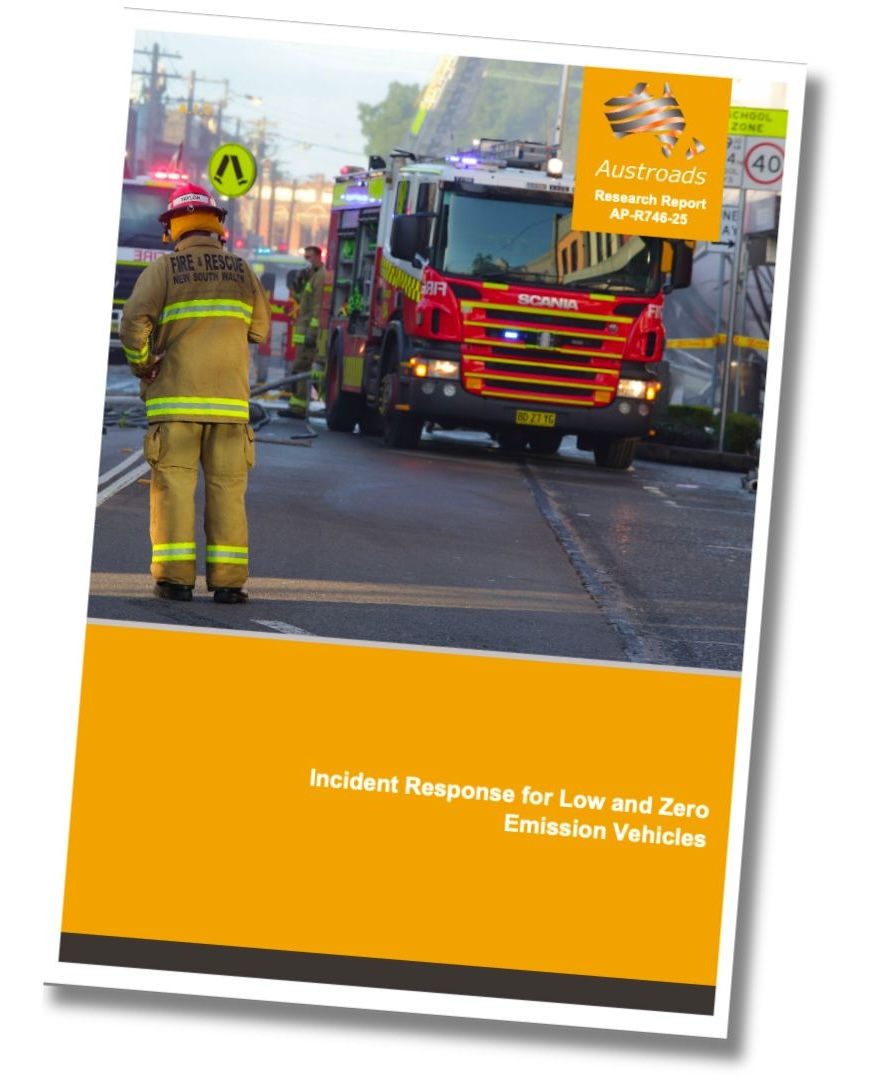
Download the Incident Response for Low and Zero Emission Vehicles from the Austroads website - https://austroads.gov.au/publications/network/ap-r746-25
What the EV Incident Response report means — and why it matters
The guidance outlines 17 recommendations covering detection, response deployment, scene management, recovery, and long-term network resilience. It recognises that while EV battery fires remain relatively rare, their behaviour differs markedly from conventional vehicle fires — requiring updated protocols and incident planning.
By co-writing this first-of-its-kind report, EV FireSafe, alongside GHD and Austroads, has helped provide a common baseline standard for EV-fire risk management across Australasia. For emergency services, transport authorities, and road managers, this means better-informed training, clearer operational guidance, and improved safety — ultimately helping communities transition to zero-emission transport while ensuring public safety and network resilience.
As EV adoption accelerates, we expect this report to become a foundational reference. We’re honoured to have played a leading role in its creation and wish to thank Austroads, the Project Control Group and Taskforce members supporting our work, plus the awesome team at GHD, especially Dr Eleanor Short and Taaj Davis. A massive shout out to EV FireSafe's friend and colleague Nathan Gore Brown from ZEV Integrations for guiding us through this paper.
We look forward to supporting roll-out, training, and continuous improvement of EV incident response practices across Australia and New Zealand; keep an eye out for our EV Assessment of Battery Condition training launching early 2026!

